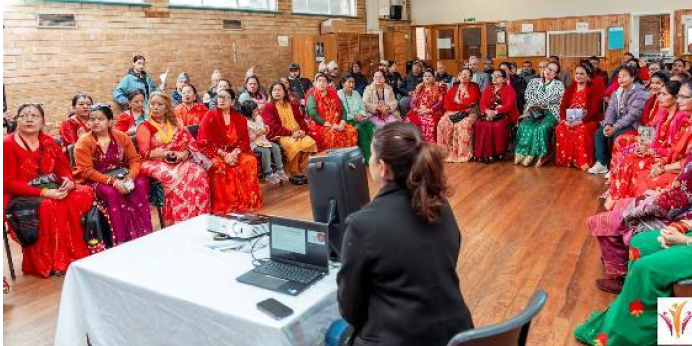
The Women’s Wellness & Empowerment Conference 2026, convened by Didibahini Women’s Network Australia (DWNA) on 7 March 2026, brought together over 170 participants, including women from culturally and linguistically diverse (CALD), migrant, and refugee communities, alongside policymakers, service providers, researchers, and advocates. The conference created a culturally safe and action-oriented platform to explore key challenges and opportunities related to women’s wellbeing, mental health, leadership, and access to services.
Across plenary sessions, keynote addresses, knowledge exchange, panel discussions, and concurrent sessions, the conference generated rich insights into the lived realities of women navigating complex and often fragmented systems. The discussions highlighted that barriers to wellbeing and participation are not singular, but multi-layered and interconnected, shaped by systemic, structural, and cultural factors.
A central theme across the conference was that access to services remains unequal, particularly for women from CALD and migrant backgrounds. Barriers such as language, stigma, limited awareness, financial constraints, and complex system navigation continue to restrict timely and meaningful access to support. These challenges are further compounded by structural issues including visa restrictions, housing insecurity, and short-term funding models.
Importantly, the conference underscored that trust is foundational to access. Many women seek support first through informal networks and community organisations before engaging with formal systems. Community-led organisations play a critical role as trusted entry points, yet they often operate with limited resources and capacity.
The discussions also revealed that current systems are largely reactive and crisis-oriented, with insufficient focus on prevention, early intervention, and long-term recovery. Fragmentation across health, legal, housing, and social services further limits the effectiveness of support systems, particularly for women with intersecting needs.
At the same time, the conference highlighted powerful examples of community resilience, leadership, and innovation. Community-led and co-designed approaches demonstrated strong potential to improve engagement, build trust, and empower women as advocates and leaders within their communities.
Emerging areas such as digital health were also explored, revealing both opportunities and risks. While digital solutions can expand access and improve service delivery, there is a risk of deepening inequities if community organisations and vulnerable populations are not adequately supported to participate in digital systems.
Based on these insights, the conference calls for a shift from fragmented, service-driven approaches toward integrated, community-centred systems that prioritise trust, cultural responsiveness, and long-term engagement. Key areas for action include:
Strengthening community-led and culturally grounded approaches
Improving accessibility and navigation of services
Investing in prevention, early intervention, and long-term support
Embedding cultural responsiveness and inclusion across systems
Addressing stigma and promoting safe spaces for dialogue
Enabling inclusive and ethical digital transformation
Strengthening cross-sector collaboration and partnerships
Ensuring sustained and flexible funding models
Centring women’s leadership and lived experience in decision-making
The conference concludes with a shared recognition that advancing women’s wellbeing and empowerment requires system transformation, not just service expansion. It calls for collective action across communities, institutions, and policymakers to co-create solutions that are inclusive, equitable, and grounded in lived realities.
At its core, the conference reaffirmed that when women are supported, heard, and empowered, they become catalysts for change strengthening families, communities, and society as a whole.